












Music ∷ Sam Porter
Show Artwork ∷ Nikolaos Pirounakis
Episode Artwork ∷ Lily Meek
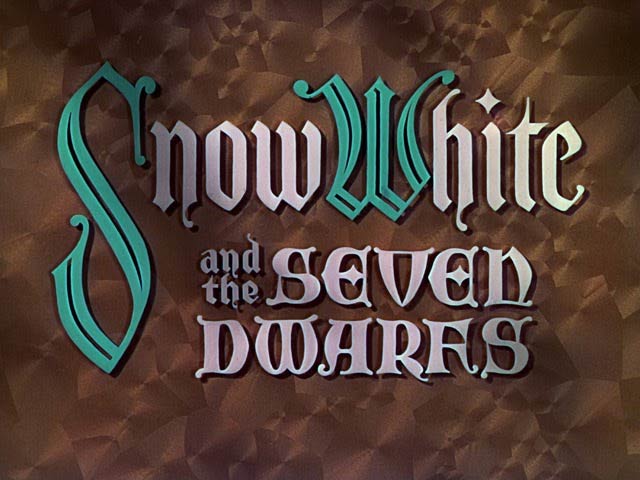
Magic mirror on the wall,
who is the fairest one of all?
Snow White (voiced by Adriana Caselotti) lives in a castle with her wicked stepmother Queen Grimhilde (Lucille La Verne), forced to work as a maid. When the Queen’s magic mirror tells her that it is Snow White, not her, that is the fairest in the land, she orders a woodsman to take her to the woods and kill her. He can’t bring himself to do it though, and Snow White escapes into the woods, stumbling upon a little house occupied by seven dwarfs, all miners for precious jewels - Doc, Happy, Bashful, Grumpy, Sneezy, Sleepy and Dopey. They take her in to live with them, while she cooks for them and teaches them to take better care of themselves, but when the Queen discovers from her magic mirror that Snow White is still alive, she turns herself into a crone, tracks Snow White down and convinces her to eat a poisoned apple, putting her into a death-like sleep. The dwarfs chase the Queen, who falls from a cliff and dies. Believing Snow White to be dead, they put her in a glass coffin, but when a Prince passes by, he kisses Snow White and she awakes, and in true fairy tale fashion, they all live happily ever after.
At 83 minutes long, 'Snow White and the Seven Dwarfs' is the first fully-animated feature-length film ever made. While animated shorts, often around 7 minutes long, had become a standard feature of most theatrical presentations, often shown along with a newsreel before a live-action feature film, it was thought that audiences would not accept one of any considerable length, or accept the idea of a cartoon character in any genuine sense of danger or peril. As popular as these shorts were, and despite the efforts of animators around the world, animation was not yet taken seriously as a legitimate art form by the general public.
The story of Snow White first appeared in print in 1812 as part of Grimms’ Fairy Tales, a collection of European folk tales set down by brothers Jakob and Wilheilm Grimm. In 1916, a young Walt Disney saw a silent film adaptation, and had always thought it a ‘perfect story’. When Disney proposed it as the subject for a feature, his brother and business partner Roy, and his wife Lillian, were skeptical, concerned that the project would ultimately be a flop. Roy eventually relented, and sought funding from Bank of America, who trepidatiously granted them the loan. The budget was set at $250,000.
As soon as it was announced, the press dubbed it ‘Disney’s Folly’, and the staff, led by supervising director David Hand, began the uphill battle to get the film made. Another concern was that bright colours for such an extended length might be too much for the audience, so a muted colour palette was adopted.
When story development began in August 1934, emphasis was placed on the dwarfs rather than Snow White. It was thought that they would be the greater attraction for the audience, but Disney became concerned that the focus on the comic characters and comic situations would impact on the believability for the audience. Instead, the focus shifted to Snow White herself as the protagonist, and a very different kind of film began to take shape. It has since become folklore around the film that Disney became fixated on one particular challenge with the film. They had used animation to make an audience laugh. But could they make an audience cry?
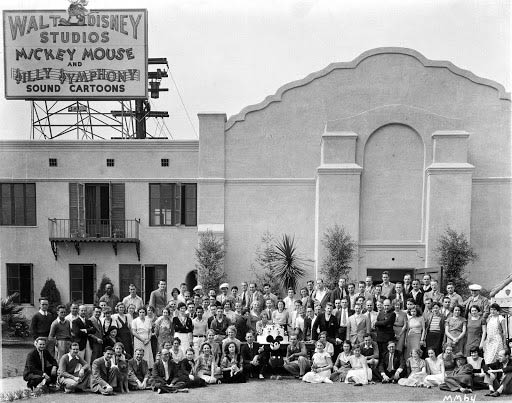
The campus was set up as both a work and a social space, with facilities for food, sports and education. Walt Disney provided drawing classes and lectures from experts in art and art history in order to support the education of his animators, as well as screenings of current and respected films to study cinematic techniques. These opportunities were extended considerably during the making of Snow White to include live-action study of animals, actors and the natural world in order to achieve greater realism.
All of the animation staff were men, as it was believed women would be too much of a distraction for the male animators. Women worked exclusively in the Inking and Painting department for significantly lower wages. They were not allowed in the animation building, and the men were likewise not allowed in the Inking and Painting building. Even with the long hours and enormous demands from Disney himself, the work provided employment and a steady income for the staff at Walt Disney Productions during the Great Depression and in the years of recovery following.
Disney’s ‘Snow White’ represents a child’s play world within the framework of a sympathetic natural world, and sets these elements in opposition to an enemy so resolute and implacable that she must be destroyed.
While the dwarfs, with their exaggerated movements and features, were easier to animate, creating believable and realistic human figures was much more difficult, and Disney knew that the success of the film rested on whether the audience would connect with Snow White herself. As with the multiplane camera, Disney decided to use the Silly Symphonies as a testing ground. He ordered into production a short called 'The Goddess of Spring' (1934), based on the Greek myth of Persephone, and the aim was to have Persephone depicted as close to reality as possible. Animator Hamilton Luske was tasked with animating Persophone, but despite the efforts of Luske and fellow animator Dick Huemer (who animated Mephistopheles), the effort was considered a failure.
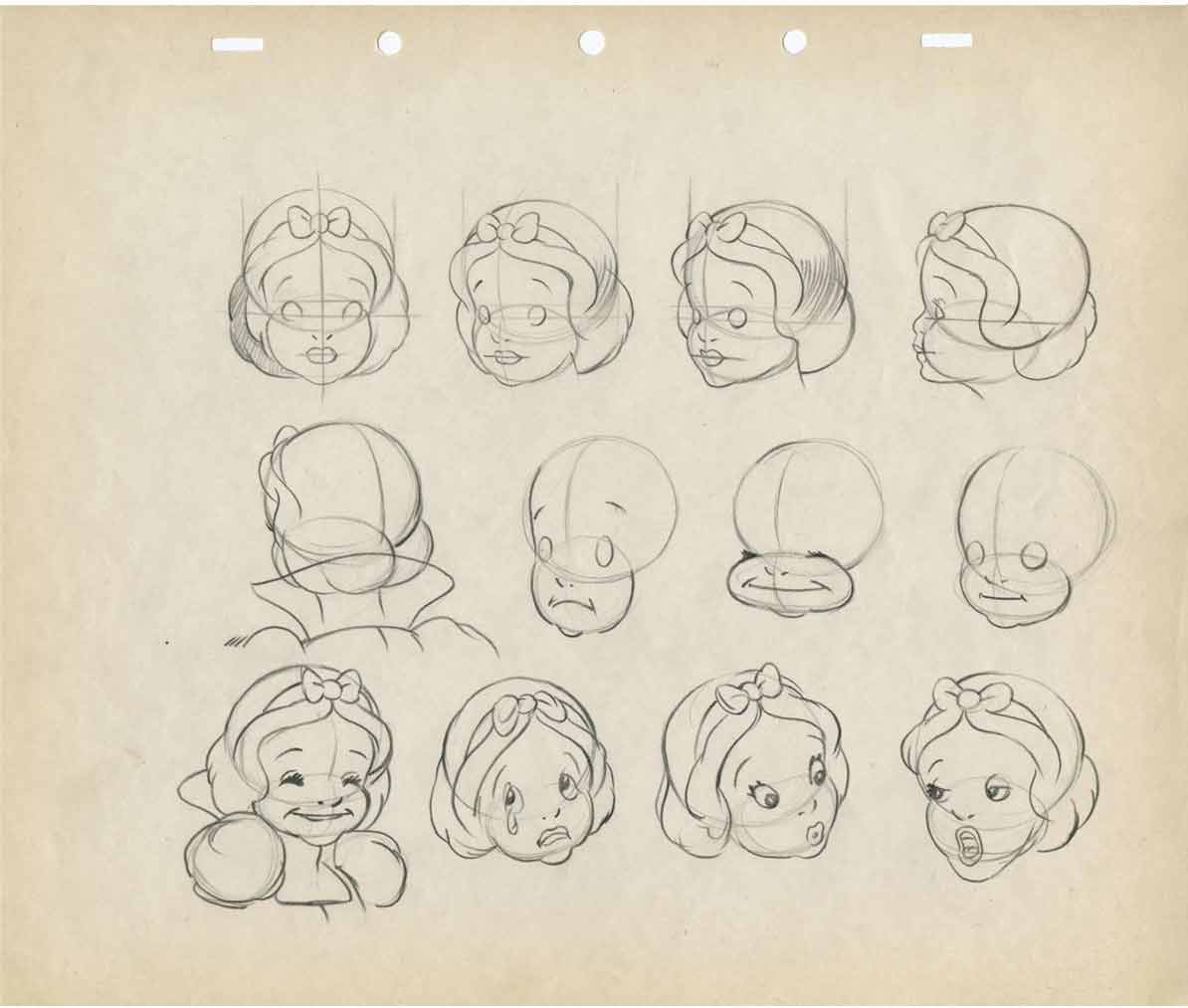
Another contribution to developing Snow White was made by the women in the Inking & Painting department. They suggested to Disney that Snow White should have a touch of red rouge on her cheeks, but Disney rejected this, saying it would be impossible for this to be consistent in every frame of the film. The ink and paint artists said not to worry, that they knew exactly how to do it because they did it to themselves every day, and proved Disney wrong.
- STORY: Character detail was conveyed in small visual stories within the main action (for example, Snow White meeting the baby blue bird in the forest, and the small interaction between the baby bird and its parents).
- ANIMATION: At night, Disney would go through the wastebaskets on the animators and look at the gags or ideas they had thrown away. If he found any he would like, he pinned it up the next morning with a note to say that it was good and should be used.
- SOUND: The echo in the well when Snow White sings “I’m Wishing” was difficult to achieve. They tested the sound in a number of reflective spaces, but none sounded right. In the end, the best results came from recording the sound in the women’s bathroom late at night.
- The film went six times over its budget, and 10 months before its premiere, no animation had actually been shot.
We weren’t ready. We needed another two or three years to do what we wanted to do with ‘Snow White'.
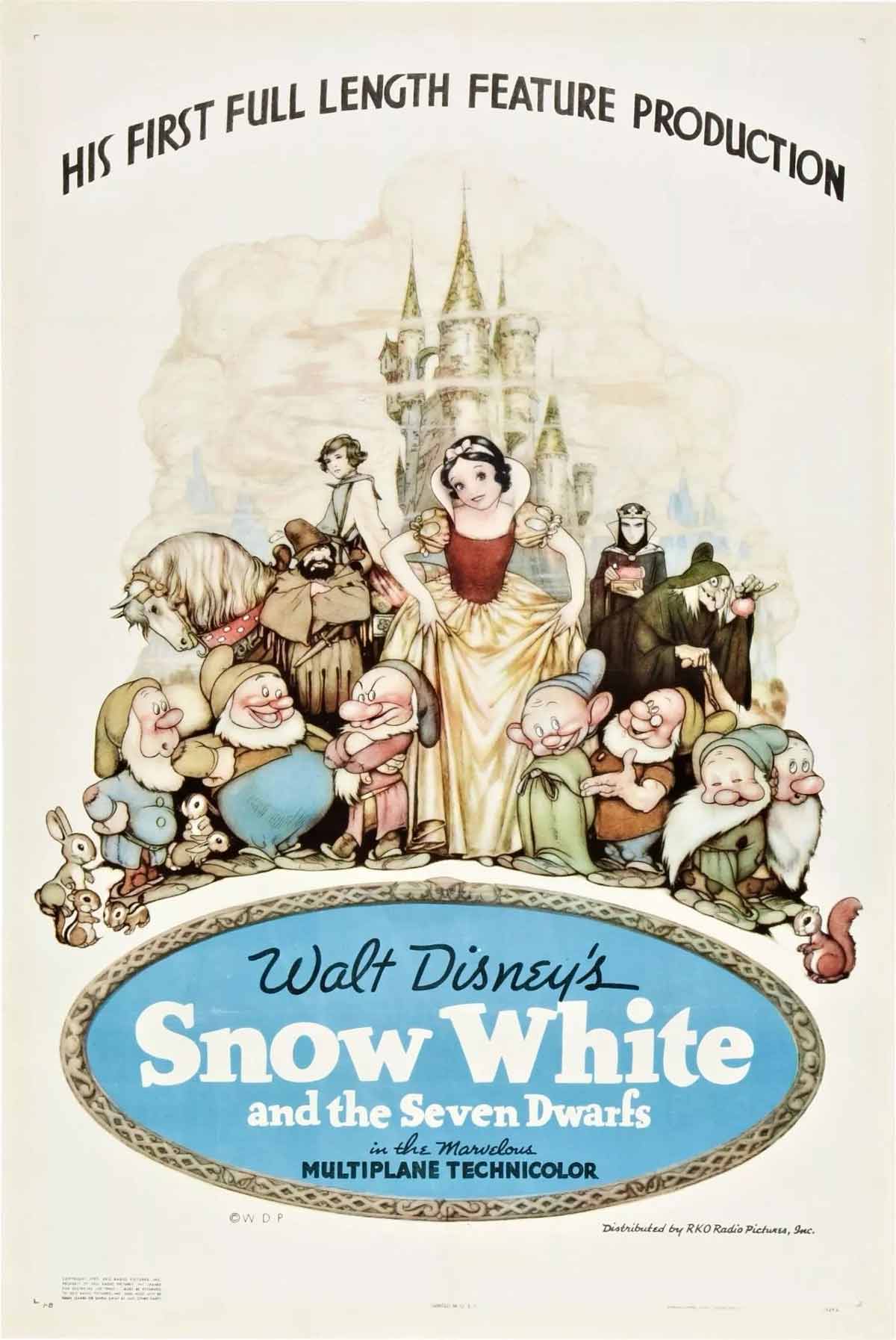
To the enormous relief of the studio and its founders, “Disney’s Folly” was met with overwhelming critical acclaim, including praise from filmmakers Segrei Eisenstein and Charlie Chaplin. After the premiere, one producer from a rival studio remarked, “I could not help but feel that I was in the midst of motion picture history”, and much to Disney’s relief, many left in tears.
So perfect is the illusion, so tender the romance and fantasy, so emotional are certain portions when the acting of the characters strikes a depth comparable to the sincerity of human players, that the film approaches real greatness.”In February the following year, after a number of exclusive engagements, RKO Radio Pictures put the film into general release, and it became a runaway box office hit. In later months, it began its rollout around the world, continuing to break records wherever it was shown. By the time it had completed its international run, Snow White had grossed nearly $8 million at the box office, making it the most successful film ever made up until that point. It also generated enormous revenue from merchandising, including the first-ever commercially released soundtrack for a film, and had an enormous cultural impact, even influencing future classics such as MGM’s adaptation of 'The Wizard of Oz' (1939).
'Snow White' returned to theatres in 1944, and once again did an impressive box office, raising much-needed revenue for the studio during the war. The film returned to theatres every seven-to-ten years until 1993, establishing the studio’s future re-release pattern for all its classics until home video, and adjusted for inflation is still one of the most successful films ever made. It would feature heavily in the AFI 100 Years, 100 Movies celebration, ranking 49th on their main list and 1st on their animated films list, and in 1993, became the first film to be entirely scanned to digital files at 4K resolution.
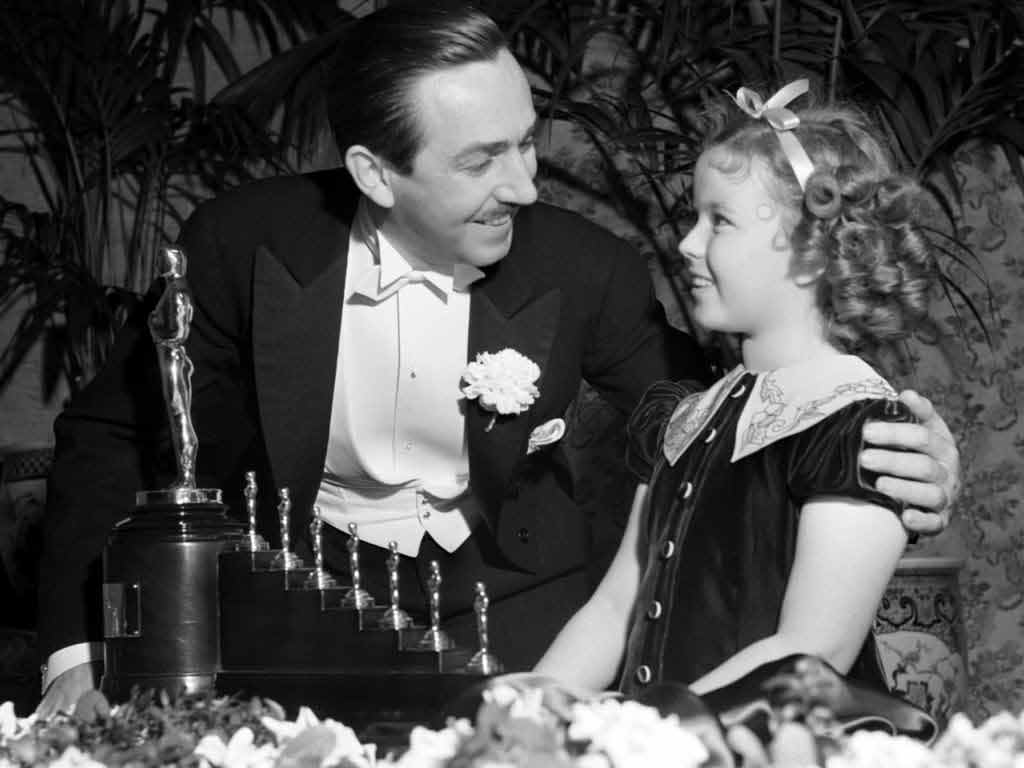
I started to hate ‘Snow White’. Every time I’d make a feature, they’d compare it to ‘Snow White’, ‘It wasn’t as good as ‘Snow White’.The phenomenal success of Snow White and the Seven Dwarfs firmly established Walt Disney and his studio as an artistic force to be reckoned with, and elevated the art of animation to new heights. Thanks to the film’s financial success, debts on the studio could be paid and further development of the facilities, including plans for a new purpose-built animation studio, could be put in place. Disney wasn’t about to rest on his laurels though, and work was begun on a slate of feature animated films, all which would push the studio and the art form to the edge of its limits, put the company at enormous financial risk and result in some of the greatest films ever made.
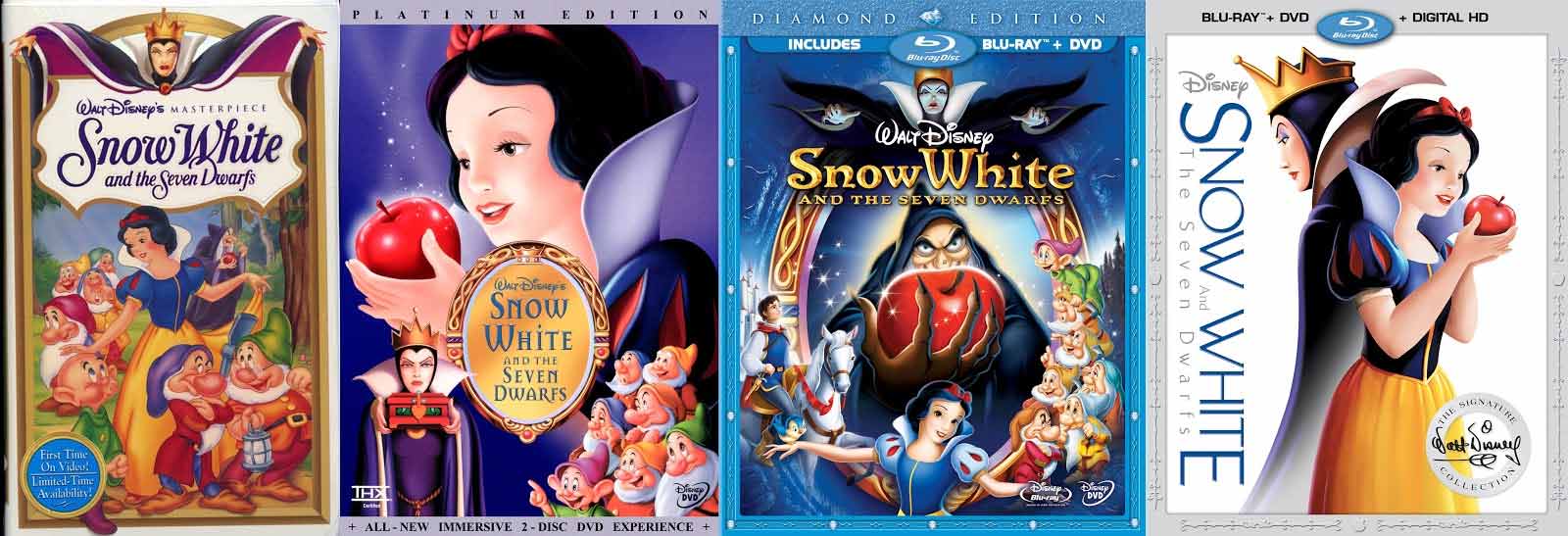
A new high-definition restoration from Lowry Digital was used for its first two-disc Blu-ray release as the first title in the Diamond Editions series in October 2009, which included extensive special features such as an interactive historical tour of the Hyperion studios. This edition was returned to the vault in April 2011, though it began to reappear a few years later in territories outside of the United States.
The most recent single-disc Blu-ray edition, as the first title in the Signature Edition series, was released in February 2016 with the same restoration, new special features added and many removed or truncated. This coincided with its first Digital HD release. At this stage, this edition is still readily available, and along with the majority of the Disney Animation canon, is available on Disney+.
- Wikipedia on Snow White and the Seven Dwarfs and Grimms' Fairy Tales
- Snow White and the Seven Dwarfs: Diamond Edition, two-disc Blu-ray, 2009
- Snow White and the Seven Dwarfs: Signature Edition, Blu-ray, 2016
- American Experience: Walt Disney, dir. Sarah Colt, PBS, 2015
- The Disney Studio Story, Richard Hollis and Brian Sibley, 1988
- Disney Animation: The Illusion of Life (Popular Edition), Frank Thomas and Ollie Johnston, 1984